
Taking my own struggle into account, I’ve taken the liberty of publishing this short story on my website to aid anyone who may be trying to find it. At the bottom of this page you’ll find scans of the original as well as a link to the full magazine issue
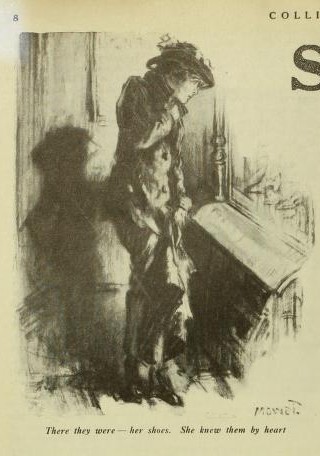
“There they were — her shoes. She knew them by heart”
. . . When the shoes became too worn to endure a third soling and she possessed but ninety cents toward a new pair, she gave up the struggle; to use her own contemptuous phrase, she “sold out for a pair of shoes.” — Jane Addams: “A New Conscience and an Ancient Evil.”
EVA opened the door and walked wearily upstairs over the soiled oilcloth runner into the dark and food-scented hall of the Mayers flat. The door of the bedroom was ajar as she passed and, as usual, her father lay sprawled comfortably on the bed, his shoes off, both pillows propped dexterously behind his back. On the table, close to his hand, was a half-empty beer bottle, a murky glass, and a can of tobacco. He was reading one of his interminable, cheap magazines.
As his daughter looked at him, stretched at an angle where the last of the daylight fell best on the page, his fat paunch billowing up thickly under his shirt, his red neck roiling into two folds where he bent it over the book, his square and alcohol-puffy cheeks mounting up under his eyes in mounds of unshaven flesh, her face flushed; her heart began to beat quickly. She longed for strength; she felt that nothing in the world would do her so much good as to seize him, to stand him upright, to make him work; work for his family — to keep him working, under the lash, if necessary.
But she was only a seventeen-year-old girl. There was nothing she could do but talk — and she had long ago realized the futility of that. She turned from the bedroom door, smoothed out the thin manila envelope that the sudden, angry clenching of her hands had rumpled, and made her way to the kitchen.
The air of the kitchen was as hot and moist as that of a tropical greenery, but the odor that filled it was not the odor of sweet-scented flowers, but the Saturday-night smell of corned beef and cabbage. Mrs. Mayers was bending over a huge iron pot, from which volumed up clouds of steam, a fork in one hand, a heavy white platter, half resting on the stove top, in the other. She turned hastily when her daughter opened the door, slid the platter up on the stove, and laid down the fork. Her eyes fixed themselves on the manila envelope, and into them leaped a hungry, ravenous look, a look almost akin to the look of physical hunger that comes into the eyes of a starving man at the sight of food. She came toward her daughter. “You got paid all right, Eva?” “Sure.” The girl held out the envelope.
Her mother took it, wiped her moist, red fingers, and extracted from it a five-dollar bill. An involuntary sigh of relief burst from her as she touched it. She opened her waist, undid a safety pin, drew out a brown bag with a couple of other bills folded in it, placed the new one with them, and deposited the bag in her bosom again.
“That’ll just make up the rent,” she said. “The butcher’ll have to wait again. I can’t help it. If he won’t give us any more meat, we’ll have to make out on what we can get from the grocery. Hillmer kicks, but he always let’s me have a little.”
Eva’s blue eyes lifted quickly and fixed themselves on her mother’s face.
“Ain’t you going to let me have the three dollars, mamma?” .she asked. “You know you promised.”
“I can’t, child, I can’t!” The older woman’s tone of one helplessly driven to do an injustice. “But you promised this week sure.” “I thought your father would have work this week sure when I promised.” She raised her voice. “Now don’t bother me any more, d’you hear? It’s money, money, money all the time, every way I turn. Sometimes I think I’ll go mad. You can’t get blood from a turnip, can you? When I ain’t got the money, I can’t give it to you, can I, Eva? You can get them next week sure. Something’s bound to turn up by then.”
The girl sat down in a kitchen chair. She examined first the sole of one shoe, then that of the other. “I don’t think they’ll last to next week,” she said anxiously. “They were really all wore out weeks and weeks ago.”
Her mother glanced at them. “Oh, they don’t look so awful bad.”
“The tops, yes. That’s because 1 blacken ‘cm so well and hitle the white places where they’re cracked round the tips. But look at the bottoms, ma!”
She held up her feet so that the soles were displayed. There were great ragged holes worn through each ; cracks and fissures radiated in all directions. The thinned leather was disintegrating like ice under a summer sun. “And, ma, the heels are so crooked that they throw my feet all sideways, and I can hardly walk.”
“Yes, yes, I know they’re pretty bad, petty.” Mrs. Mayers turned her worried, harassed eyes away from her daughter. “But you got to make them do another week.”
The words echoed in her own brain. It seemed to her that her whole life was tuned to this refrain of making things “do” another week, or another two weeks, or another three weeks longer, that she was forever endeavoring to stretch objects beyond their natural time of use, forever madly bringing the sickening chasms between Mr. Mayers’s spasmodic periods of work. The black hand of poverty seemed always to hover just above her family, menacing, terrible, eager to close over them, to crush out their hearts, their lives. It seemed as if they had only her mother’s strength to push it away, to keep forever pushing it away as it forever returned.
Monday morning before she started for her work at Snider’s Five, Ten and Fifteen Cent Store, where she was a sales girl, Eva carefully cut out a pair of soles from a cardboard box and inserted them in her shoes. That night, very delicately, so as not to strain the tender leather, she removed what was left of the soiled and worn bits of cardboard. There were raw, red welts along her feet where the edges of the improvised soles had pressed; there was a painful blister coming on her right heel. But in spite of these inconveniences, she felt a little cheered at her discovery of this new use for old boxes. She cut out and inserted new soles for the next day.
But the next morning it began to rain — the sad, persistent, melancholy rain of autumn. Before she had walked five of the eight blocks between her home and the store, her fair-weather soles had soaked through, peeled off, melted away and mingled with the elements. She felt the cold dampness of the pavement creep through her stockings and lie against her bare feet. All that day between the intervals of waiting on the five, ten, and fifteen cent customers, she picked tiny splinters out of her feet, for the floor of Snider’s Emporium had anything but a hardwood finish.
That night, although she was dog-tired and the rain was pelting down in long, slant lines, she stopped automatically before a certain shoe-store window. They were there — behind the plate glass that glistened with rain drops — her shoes. She had picked them out weeks ago, a buttoned pair of gun metal shoes with thick, firm, water-tight soles, and heels that were as straight as a die. She knew them by heart, from the little oblong white card with the mark $3 on it to the pattern of the perforations on the leather tips. Next Saturday she would have them! She counted the days on her fingers — Wednesday, Thursday, Friday, Saturday. For a moment she lost herself in a dream. She already possessed them; she could feel them on her feet, the heels straight and even, the good, substantial soles between her and the rain-washed pavement.
SHE turned away with a sigh and went on to the end of the block. At the corner she hesitated. If she turned, she could take a short cut to the side street where she lived. But the short cut led through a district which she had hitherto instinctively avoided; a district of cheap, transient hotels, of garish, late-running restaurants where food could be procured, but drinks and cabaret usually filled all demands; of wine shops, saloons, and cigar stands, each with its quota of lazy-eyed men and boys hanging around it.
But with the chill autumn rain drenching her and the pavement wearing out her stockings, Eva ‘ could not afford to be particular. She turned her j head away from the even, unhurried, appraising stares of the men behind the plate glass of the | hotel lobbies or gathered in from the rain in cigar- ; store entrances; but the women who dipped in and out under umbrellas her eyes invariably followed. These women were warmly clad and — her fascinated gaze always fixed on their feet—well shod.
Wednesday and Thursday it continued to rain. Great holes too big to darn wore in Eva’s stockings, and she mended them with pieces from old ones. Every night she scraped the caked mud from the bottoms of her bare, swollen feet, then soaked them in hot water. She caught a bad cold. Her throat hurt her, and her head ached. Her wet feet were like lumps of ice all day — lumps of ice which nevertheless stung and burned. When Friday came she was so utterly miserable that it seemed to her as if she could hardly live until Saturday night when she would get her new shoes.
Every evening she took the short cut through the district of cheap, transient hotels and tawdry cafes, and every evening her eyes, as if drawn by a magnet, noted the well-shod feet of its women.
During this week of misery it seemed to Eva that she suddenly grew up. Sometimes she lay awake in the night, wide-eyed, very still, in order not to disturb her two little sisters who shared the bed with her. She would think with terror there in the dark of the fate of her family. It seemed as if always, since she could remember, they were slipping down the sides of a steep precipice toward a black and horrible gulf of poverty that would annihilate them. They would make terrible and extraordinary efforts at the brink; they would climb away a little piece from the awful edge — then the slipping and sliding down would begin again. Eva had spasms of savage hatred for her father. He could save them if he would. He had it in his power. He could earn good money if he would only work steadily like other men. Her mother could save; they could all of them crawl to a position of safety away from the pit’s edge. But all burdens slipped off Mr. Mayers’s shoulders with a sort of sickening ease.
With the shadow of such a night upon her she sat Saturday at noon on a bench of the square where she usually went to eat her lunch of bread-and-butter sandwiches. The rain had stopped. She watched the people streaming in and out of the big hotel which raised its gray marble portals just opposite. She looked especially at the young girls who came in the pretty little electrics, lined with lavender or old rose, a single long-stemmed flower nodding in the slender vase opposite them. As she watched them, Eva knew she did not envy them their clothes, their jewels, their fresh skins; what she did passionately envy them was their lack of fear. They had no fear of the pit. They hardly knew there was one; they were kept far away from its terrible edge, in pleasant meadows, flooded with sunshine, full of flowers. They grew up like flowers themselves, joyously, carelessly, sweetly.
Saturday evening when she opened the kitchen door the thick, steamy smell of corned beef and cabbage again assailed her nostrils. She handed her pay envelope to her mother and waited eagerly. Her shoes were waiting for her. The stores kept open late on Saturday night. She had seen them in the lighted window as she passed.
Mrs. Mayers took the envelope, opened it, looked at her daughter, hesitated, then frowned and turned away. “Ain’t you going to give me the three dollars, mamma?” asked the girl in a low voice.
Mrs. Mayers bent over her cooking:
“You’ll have to wait till next week, Eva.”
The girl stood silent at the familiar words — stunned, looking down at the floor.
“I simply can’t do it, child. Your father didn’t get work, you know. No one will let us have anything more now except for cash — an’ we got to eat.” The mother spoke bitterly, a sense of her own helplessness in her heart.
EVA continued silent. After all, she had known it would be this way, yet she had somehow thought that when her need became absolute there would be some way of filling it. But, yes — they must eat. She felt suddenly as if she were caught in a trap; she did not know what to do or where to turn. No ingenuity would keep the shoes together another week — hardly another day. What should she do?
The kitchen door opened and her two little sisters and her little brother came in. They seated themselves at the kitchen table. Eva did not notice them. She still stood without moving, looking at the floor. A moment later her father came in. He carried a magazine in his hand, his fingers thrust between the leaves to keep his place. It was Mr. Mayers’s custom to prop his magazine against the sugar bowl and continue an interesting story during the meal. He even irritably required silence of the rest of the family so that he would not be disturbed during this process. Eva looked up and saw him as he was about to seat himself comfortably at the table. Suddenly red spots glowed on each of her cheeks. “Papa!” she said in a shaking voice.
MR. MAYERS turned around with mild surprise. “Papa,” she said, “I have to have a pair of shoes!” Her voice rose shrilly. “I have to have them! I have to have them! Look!”
She sat down on a chair and thrust both her feet out. “Why,” said Mr. Mayers with vague sympathy, “they’re all wore out, ain’t they? You ought to get another pair.”
“I have no money,” answered the girl in a flat, monotonous voice.
“You ought to take it out of what you earn.” One of the myths of the Mayers household was that Mr. Mayers’s desultory labor adequately supported his family. He never admitted that Eva’s money was not her own. It would have hurt his manly pride.
“I give all my money to mamma.” Eva still spoke in the same monotonous voice. She had long ago learned the uselessness of trying to make her father face an issue squarely.
“Well, well,” said Mr. Mayers genially, as if he were pleasantly surprised at the charming but unnecessary generosity of a child who presents its parent with one of its toys, “that’s a good girl, that’s a good girl. Give your mother all your money — eh?” Mr. Mayers smiled benignly.
He thought a moment. “I’ll give you money for the shoes Monday,” he said off-handedly. “I’ll be working again Monday.” He sat down and propped his book up. As far as he was concerned the subject was dismissed.
Eva did not reply. A coldness, a fear gripped her heart. The horrible part of that promise was its definiteness, which somehow always carried a lure of hope — and its certainty of failure. Mr. Mayers was no more sure of work Monday than any other day, and when Monday came he would feel under no necessity of obtaining it. He would have long ago forgotten his promise.
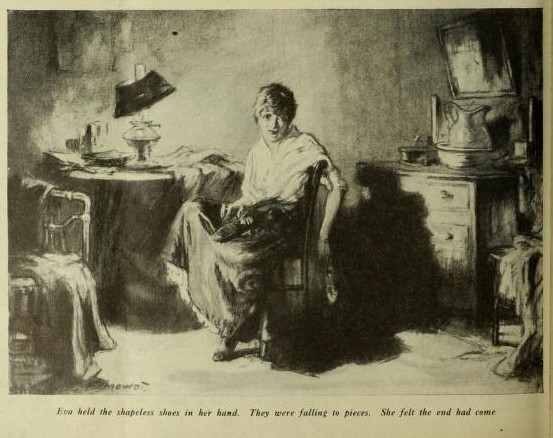
After supper Eva went to the room shared by her and the two little girls. She took off her shoes with the utmost, care. She held the shapeless things, with which she had become so tragically familiar, in her lap and looked at them. It was only a matter of hours — a day at the utmost — before they would literally fall to pieces. A feeling of calm came over her — an odd sense of finality.
SHE got up in her stocking feet, put on a freshly ironed white waist and the longest of her two black skirts. She slipped on the shoes again; the length of the skirt somewhat covered them. She combed out and did up, high on her head, her soft, straight brown hair. She brushed and put on her rusty black sailor hat and her little blue jacket.
As she went through the kitchen she stopped, turned to her mother, and said : “Mamma, will you give me a dime? I want to go to the movies.” “Yes, honey.”
Every dime was precious, but in the face of the greater disappointment her mother hastened to grant this request. She had been troubled by the look on her daughter’s face at dinner, and she was glad that she was now going out instead of spending the evening alone in her room.
The night into which Eva stepped was clear and moonlit; one of those mild and lovely autumn nights which are sent to cheer for a moment a world weary of dampness and dreariness and all the windy menace of oncoming winter. The shadows of the houses were cut sharply and blackly on a steel-blue matrix of moonlight, and even this poor street of flat dwellers took on something of mystery and romance under the wand of the night.
But all its soft beauty was lost on Eva. She heard nothing but the scrape, scrape of her loose sole edges against the pavement; felt nothing but the intolerable ache in her swollen feet.
She turned abruptly into the district which she traversed every day on her way to and from work.
Here the quiet of the moonlight was lost in multitudinous electric lights; they blazed everywhere; plain yellow electric signs that stood still and said what they meant; mad, multicolored, rainbow-tinted electric signs that whirled and gyrated, bloomed and changed like flower gardens gone mad. The district looked tawdry and unalluring in the daytime, but now, under the radiance of its electric lights, it awoke, like the girls who frequented it, to the artificial life and vivacity that were its nightly business. The doors of cafes swung open and shut; girls, singly, in pairs, or with men, went in and out; strains of music rushed forth. All was set in that brilliant glare of strong light like some gigantic, tropical forest abloom with open-petaled, poisonous flowers that snapped shut on and devoured whatever touched them.
EVA slowed her walk in front of one of the below-street-level cafes, white painted, under a downpour of white light. Above its entrance blazed a sign bearing the words “The Blue Goose”; this was aided and abetted by a scintillating bird with azure plumage pricked out in tiny blue electric bulbs. She stood still a moment, then with a sudden, stiff movement went down the steps. As she crossed the threshold of the door held open for her by a uniformed attendant, she was conscious of the softness and smoothness of the deep carpet against the soles of her weary feet. . . .
Monday night Eva came home from Snider’s Five, Ten, and Fifteen Cent Store. When she passed through the hall she noticed that the bedroom was empty. She opened the door of the kitchen. The dinner was steaming on the stove; her mother was wiping the dishes and, as she wiped them, setting the table. She looked up and smiled as Eva came in.
“Papa isn’t home yet,” she said; “maybe he’s got a job at last.”
The girl did not answer, and something in her silence caused her mother to stop in her plate wiping and look up. Her daughter met her glance, but in a curious, forced way. Of a sudden, instinctively, the mother’s eyes sought the floor. “Why, you — you got your shoes!” she said in surprise.
“Yes.”
The mother opened her mouth, caught the question at her lips, and remained silent. Suddenly her eyes caught her daughter’s. They stood looking at each other and in that one tortured glance the mother comprehended all. All at once the forced calm of the girl’s face broke; little tremors and quivers ran over it; a sort of spasm twitched the corners of her mouth.
Her mother rushed over and folded her in her arms :
“My baby, my baby, my poor, poor baby!” she crooned tenderly over the sobbing girl. “Never mind, never mind, darling, mamma understands.”
She patted and kissed the head of the girl who lay in her arms. A passion of tenderness welled up in her heart for her daughter. The tears flowed down her cheeks. She forgot for the moment all her other children. This was her all, her first-born, her baby, and she had come to this.
SHE continued to pat Eva’s hair and her wet cheek and soothe her with mother words. But as the girl’s sobbing grew less a numbing sadness crept over the older woman. She felt, crushing her soul, the vast weight of forces she did not comprehend; she felt all her powerlessness to save from the world this life she had brought into it. She glanced down past the girl’s shoulder and breast — there were her two poor little tired feet incased in their stiff new shoes. She realized with a terrible bitterness that this flower had not had a fair chance to bloom in the garden of life. The worm of poverty had entered the folded bud and spoiled it. This was the terrible thing about poverty: it took the tender young life before it had strength to grow and fight it. This was its awful menace to all the future.
The door opened and closed at the foot of the stairs. At the sound mother and daughter sat up straight, in a listening attitude.
“It’s papa! Come, sweetheart, bathe your eyes so’s he won’t think anything!”
She slipped a towel into the girl’s hand and pushed her gently toward the sink. He was an alien. He would judge her as the outside world would judge her. Whatever happened, his pride as a father and the head of a household must be kept from being humbled.
When he came in they were both bent over the stove.
“I got a job to-day, mother,” he announced proudly, holding his hands out to the warmth.
“Did you? That’s good.” He looked at his wife with a grunt of disapproval. She showed far less enthusiasm than he thought the occasion demanded. The three younger children came in noisily.
“Come, let’s sit down to supper,” she said. “Come, petty,” she turned to her daughter and gently took her hand, “come and eat.”
Whatever happened, life must go on. Whatever boats are wrecked, the river does not stop flowing toward the sea.
Sources
‘Shoes’ by Stella Wynne Herron in Collier Magazine’s January, 1916 issue
